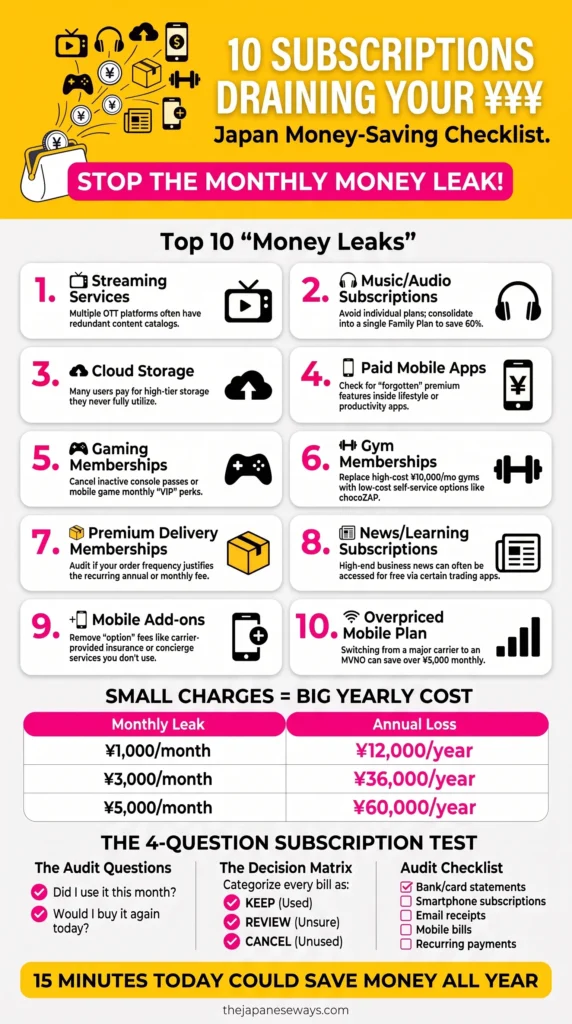
Whether you are navigating the high-rent districts of Tokyo or settling into a quiet life in Osaka, we all feel the financial pinch. Small, automatic monthly charges quietly accumulate into massive yearly expenses that drain your bank account.
To cancel subscriptions in Japan and effectively reduce monthly expenses in Japan, you must identify the “invisible leeches” in your budget. We’ve seen too many residents fall into the trap of “subscription fatigue,” where recurring costs provide zero value.
PR
Common subscriptions that foreign residents often overlook include:
Forgotten smartphone “utility” or fitness apps.
“Ghost” gym memberships you haven’t used in months.
Premium delivery services that don’t justify the monthly fee.
Redundant cloud storage across multiple providers.
The Math of Monthly Costs
Minor monthly fees have a staggering impact on your long-term wealth. When viewed as an annual total, a “small” ¥1,000 charge becomes a significant financial burden.
Monthly Charge
Yearly Cost
¥1,000
¥12,000
¥3,000
¥36,000
¥5,000
¥60,000
Our goal is to remove low-value expenses that create “financial drift.” This isn’t about a total lifestyle blackout; it’s about reclaiming your yen for things that actually improve your life.
The 10 Most Common Subscriptions to Review and Cancel
Video Streaming Services
Many residents practice “content-driven subscription” behavior—signing up for one show and forgetting the service exists. If you aren’t watching daily, cancel and rotate services. Pro Tip: If you need DAZN for sports, consolidate your costs with the DMM x DAZN bundle. It offers significantly better value than paying for both separately.
Music and Audio Subscriptions
Audit your music usage. If you aren’t frequently using offline downloads or high-fidelity audio, you might be overpaying for “Premium” features. Most free tiers are sufficient for casual listeners.
Cloud Storage
Check your Google, Apple, and Microsoft accounts. You may be paying for 200GB on one and 50GB on another. Consolidating your data into one provider can save you several hundred yen every month.
Paid Smartphone Apps
Open your iOS or Android subscription settings right now. You’ll likely find “utility” apps or fitness trackers charging you ¥500 to ¥1,000 monthly. If you haven’t opened the app in 30 days, hit cancel.
Japan Subscription Money Saving Checklist
Gaming Memberships
Review your play frequency. If your Switch or PlayStation is gathering dust, cancel the online membership. You can always re-subscribe in minutes if a new multiplayer title catches your interest.
Gym and Fitness Memberships
This is the ultimate “unused membership” trap. If you have not visited your gym at least twice a week over the last month, the cost-per-visit is likely too high to justify.
Premium Delivery Memberships
Evaluate if your shipping savings actually outweigh the monthly fee. Unless you order multiple times per month, the “free shipping” perk is often an expensive illusion that costs more than standard delivery.
PR
News and Learning Subscriptions
Are you actually reading those paid articles or using that language app? Switch to free alternatives like NHK News Web Easy or public library resources to get the same value for zero yen.
Mobile Phone Add-Ons
When you sign up at a carrier shop, staff often bundle “hidden” charges like device insurance, security packages, or extra storage. These are buried in your bill and are usually the first items we recommend cutting.
The NHK Subscription (Special Case)
Canceling NHK requires you to prove you have no equipment capable of receiving their broadcast. This means you must throw away, sell, or transfer your television. Required proofs of removal:
Recycling ticket (if discarded).
Sales certificate or receipt (if sold via Mercari/Second Street).
Transfer details (the address and name of the recipient).
Action Step: Call the local sales department of your regional NHK station directly. Do not call the Fureai Center; the local bureau can process your cancellation in under three minutes.
Why “Subscription Fatigue” is Real in Japan
The National Consumer Affairs Center (CCJ) reports a massive rise in subscription-related frustration. Modern digital life has become a maze of recurring charges that are increasingly difficult to exit.
The global subscription economy is projected to exceed USD 1.5 trillion by 2033.
CCJ 2025 reported a record 9,127 “cross-border” complaints (a 1.5x increase from 2024).
“Cancellation troubles” represent 53.0% to 57.2% of all complaints in Japan.
Many unintended subscriptions involve international sites based in the US or Cyprus.
The “Kakeibo” Strategy: Japanese Wisdom for Modern Savings
The Kakeibo method (invented in 1904) is the perfect antidote to digital drift. By using a notebook and pen, you create “physical friction” that makes you feel the impact of every yen.
10 Subscriptions Draining Your Money
The Kakeibo Subscription Checklist:
[ ] Save First: Write your savings goal at the top of the page before any spending occurs.
[ ] Handwrite Everything: Neuroscience confirms that writing by hand activates deeper memory encoding than typing into an app.
[ ] Categorize the Four Pillars: Sort every expense into Needs (rent/food), Wants (comfort), Culture (books/learning), or Unexpected (emergencies).
[ ] Target the 17%: Aim for the Japanese household saving rate of 17% (contrast this with the 4-5% US rate).
[ ] The 5% Rule: Set aside 5% of your paycheck immediately for your personal goals or rewards.
The 30-Day Subscription Audit Checklist
Take back control of your finances by following these three diagnostic steps:
PR
Bank Statements: Check the last 3 months for recurring names you don’t recognize.
Smartphone Menus: Open your “Subscriptions” tab in iOS or Android settings.
Email Search: Search your inbox for keywords like “Renewal,” “Receipt,” or “Confirmation.”
The Test: Did I use this in the last 30 days? Would I buy this again today? Is there a free solution? If the answer is “no,” cancel it now.
Before vs. After: The Impact of a Subscription Cleanup
A thorough cleanup can transform your finances. For many residents, the savings below cover nearly two months of rent over the course of a year.
Item
Before
After
Monthly Saving
Mobile Plan
¥7,500
¥3,278 (Rakuten)
¥4,222
Unused Gym
¥8,000
¥0
¥8,000
3 Streaming Apps
¥4,500
¥1,500 (Rotate 1)
¥3,000
Total
¥20,000
¥4,778
¥15,222
Total Annual Savings: ¥182,664
What NOT to Cancel
Do not sacrifice your well-being or career for the sake of a few yen. Keep your health insurance, essential work tools, and services that provide daily value. In Kakeibo, the “Culture” category is vital—never cancel a service that genuinely contributes to your long-term growth.
Conclusion
The “invisible drain” on your yen stops tonight. By auditing your subscriptions and applying the Kakeibo philosophy of “saving first,” you can reclaim thousands of yen for your future.
FAQ Section
How do I prove I don’t have a TV for NHK?
You must provide a “proof of removal.” This can be a recycling ticket if you threw it away, a sales receipt/Mercari screenshot if you sold it, or the name and address of the person you transferred it to.
Why should I write expenses by hand instead of using an app?
Handwriting forces your brain to process the data more slowly. Neuroscience research shows that the physical act of writing activates deeper memory encoding, making you more mindful of your spending.
What is the most common subscription complaint in Japan?
According to the National Consumer Affairs Center (CCJ), the most common issues are “cancellation troubles” (53-57% of complaints). This includes hidden cancellation buttons and unintended contracts.
What are the four categories of Kakeibo?
Every expense should be categorized into Needs (essentials), Wants (pleasures), Culture (personal growth), or Unexpected (unplanned costs).
Is Rakuten Mobile’s pricing a flat rate?
No, it is tiered. You only pay for what you use, which prevents “financial drift”—a core principle of the Kakeibo system.