Still paying high monthly fees to SoftBank in 2026? As the Japanese economy navigates a complex period of rising living costs and fluctuating inflation, the “mobile bill tax” remains one of the most significant avoidable expenses for expatriates and residents alike. For over a decade, the Japanese telecom market was defined by a comfortable oligopoly. However, the landscape in 2026 has shifted from a rigid three-player system into a fierce battle between the established giant and an aggressive, cloud-native challenger.
In this strategic analysis of rakuten mobile vs softbank, we evaluate whether the “Big Three” premium is still justifiable. SoftBank continues to command a massive 24.8% market share with approximately 54.8 million subscribers, while Rakuten Mobile has finally crossed the critical psychological threshold of 10.01 million subscribers. This growth is not accidental; it is driven by a fundamental shift in how mobile networks are built and how loyalty is rewarded. For the consumer, the question is no longer just about “bars of signal,” but about the total financial efficiency of their digital life.
PR
Rakuten Mobile vs SoftBank – 2026 Plan Comparison
To understand the price gap, one must look at the divergent corporate philosophies. SoftBank operates on a high-ARPU (Average Revenue Per User) legacy model, where revenue is maximized through complex bundling. Rakuten Mobile operates as a software company that happens to run a network, utilizing a virtualized Open RAN architecture to keep overhead low. This difference is reflected directly in the monthly “SAIKYO Plan” (Strongest Plan) versus SoftBank’s “Merihari Unlimited.”
Feature
Rakuten Mobile (SAIKYO Plan)
SoftBank (Merihari Unlimited)
0 – 3GB Usage
¥1,078 (tax incl.)
¥7,238 (Base Price)
3GB – 20GB Usage
¥2,178 (tax incl.)
¥7,238 (Base Price)
Unlimited Data
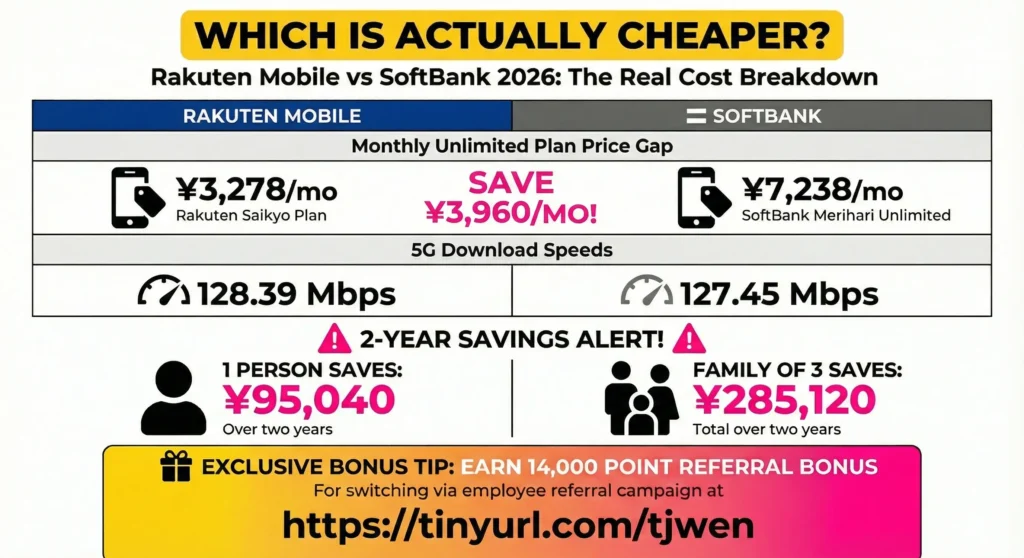
¥3,278 (tax incl.)
¥7,238 (Base Price)
Contract Binding/Fees
None (¥0 Cancellation)
None (standard for 2026)
5G Support
Included (Market-leading 5G speeds)
Included (Strong overall blended speed)
eSIM Availability
Yes (Instant MNP One-Stop)
Yes
International Roaming
2GB Free (70+ countries)
Extra cost (Global roaming packs)
Calling App
Rakuten Link (Free domestic calls)
¥1,980/mo (approx. for unlimited)
The data confirms a massive disparity: Rakuten’s unlimited data ceiling of ¥3,278 is roughly 45% of SoftBank’s ¥7,238 base price. Even if an individual user qualifies for SoftBank’s various sub-discounts, they are unlikely to ever reach the price floor that Rakuten offers as a standard.
Real Cost Breakdown (2-Year & 3-Year Total)
When analyzing the softbank vs rakuten price dynamic, we must consider the “long-tail” savings. Most consumers in Japan stay with a carrier for at least 24 to 36 months, often aligned with device payment cycles. While a monthly difference of ¥4,000 might seem like a manageable “luxury” for SoftBank’s brand name, the multi-year totals tell a different story of missed financial opportunity.
The following scenarios are calculated based on 2026 base prices. We exclude temporary 6-month “campaign” discounts to show the sustainable cost of ownership.
Scenario A: The Light User (under 3GB)
Ideal for the “Wi-Fi Warrior” who works from home and uses cellular data only for essential navigation or messaging.
Rakuten Mobile Monthly: ¥1,078
SoftBank Monthly: ¥7,238
24-Month Total: Rakuten (¥25,872) vs. SoftBank (¥173,712)
36-Month Total: Rakuten (¥38,808) vs. SoftBank (¥260,568)
Savings Difference:¥221,760
Scenario B: The Medium User (20GB)
The standard modern user who streams music during commutes, uses social media heavily, and occasionally watches YouTube in HD.
Rakuten Mobile Monthly: ¥2,178
SoftBank Monthly: ¥7,238
24-Month Total: Rakuten (¥52,272) vs. SoftBank (¥173,712)
36-Month Total: Rakuten (¥78,408) vs. SoftBank (¥260,568)
Savings Difference:¥182,160
Scenario C: The Heavy/Unlimited User
The “Digital Nomad” or power user who uses 100GB+ monthly for 4K streaming, tethering to a laptop, and gaming.
Rakuten Mobile Monthly: ¥3,278
SoftBank Monthly: ¥7,238
24-Month Total: Rakuten (¥78,672) vs. SoftBank (¥173,712)
36-Month Total: Rakuten (¥118,008) vs. SoftBank (¥260,568)
Savings Difference:¥142,560
As a senior strategist, I look at the ARPU (Average Revenue Per User) as a health metric for the wallet. Rakuten’s ARPU sits at approximately ¥2,467, whereas the industry benchmark for high-tier carriers like NTT Docomo (and by extension SoftBank) remains near ¥3,990. By staying with SoftBank, the average individual is essentially paying a “legacy tax” of over ¥1,500 every single month compared to the market average.
Why SoftBank Often Ends Up More Expensive: The Legacy Strategy
SoftBank’s 24.8% market share is maintained through a “blended network experience” and an ecosystem that rewards the family unit but penalizes the individual. To truly understand why your bill is so high, we must deconstruct the SoftBank ARPU strategy.
1. The “Family Discount Trap”
SoftBank’s advertised low prices are almost always contingent on the “Shin-Minna Kazoku Wari” (New Everyone Family Discount). To get the ¥1,100 discount, you need at least three people on the same plan. For the solo expat or a couple, you are immediately forced into the highest price tier. Rakuten, by contrast, provides its lowest price to a single user without any “family” requirements.
PR
2. The Home Internet Bundle (SoftBank Hikari)
SoftBank aggressively pushes “SoftBank Hikari” or “SoftBank Air” to unlock another ¥1,100 discount. While this looks good on paper, it tethers you to a legacy fiber provider that may have higher installation fees or slower speeds than modern alternatives. If you decide to move apartments or switch internet providers, your mobile bill instantly spikes by over ¥1,000.
3. Device Installment and Optional Add-ons
SoftBank’s retail strategy relies on “support services” and “security packs” that add ¥500 to ¥1,500 to the bill. Furthermore, their 48-month installment plans often include a “trade-in” requirement that makes it difficult to actually own the device or switch carriers midway through.
Why Rakuten Mobile Is Often the Cheapest Mobile Plan in Japan
Rakuten Mobile has become the cheapest mobile plan japan by leveraging its status as a tech company first and a telco second. Their “SAIKYO Plan” is designed for the modern user who demands simplicity.
The Power of the “SAIKYO” Tiered Model
Unlike SoftBank, where you pay for “Unlimited” even if you only use 5GB, Rakuten’s plan is elastic. If you travel home for the holidays and use 0GB, your bill is ¥1,078. If you stay in Tokyo and use 200GB, it caps at ¥3,278. This “Pay-for-what-you-use” philosophy eliminates the waste inherent in SoftBank’s rigid structure.
Rakuten Link: The Hidden Budget Saver
Standard calling in Japan costs approximately ¥22 per 30 seconds. SoftBank users often pay for a “Kake-hodai” (All-you-can-call) option for ¥1,980. Rakuten Link provides free domestic calls via data, saving users nearly ¥24,000 per year compared to paying for a calling add-on at a major carrier.
The Ecosystem Net-Cost Analysis
According to the Japan Loyalty Business Report 2026, the loyalty market in Japan is a $5.48 billion industry. Rakuten Points are the “unifying layer” of this ecosystem.
The Net-Zero Bill: High-volume Rakuten Ichiba shoppers often earn enough points to pay their entire mobile bill.
The Multiplier Effect: Being a Rakuten Mobile subscriber automatically increases your point-earning potential (SPU) by up to 4x. In a strategic sense, the mobile plan isn’t just a cost; it’s a tool to reduce the cost of your groceries, travel, and insurance.
Network Quality & Coverage: The 2026 Reality
A common objection to switching is the perceived “poor signal” of Rakuten. However, Q3 2025 data from Speedtest Intelligence suggests that SoftBank’s lead is narrowing, and in some areas, Rakuten has already overtaken the giant.
Performance Data Breakdown (Q3 2025)
Blended Speed: SoftBank leads in overall download speed across 4G/5G technologies at 62.05 Mbps. This is their “blended” strength.
Pure 5G Speed:Rakuten Mobile leads Japan with a massive 5G download speed of 128.39 Mbps, compared to SoftBank’s 127.45 Mbps. If you live in an urban center with a 5G-capable phone, Rakuten is objectively faster.
5G Availability: SoftBank recorded 26.5% 5G availability, while NTT Docomo led at 38.4%. Rakuten focuses its 5G density in high-value urban corridors like Tokyo, Osaka, and Kanagawa.
The Urban-Rural Performance Gap
The 2026 data shows a significant regional divide:
PR
Osaka: Boasts 35.2% 5G availability, with median speeds reaching 172 Mbps.
Yamanashi: Only 9.1% 5G availability, showing the struggle for advanced networks in mountainous regions.
SoftBank Strength: SoftBank delivers its highest minimum performance (10th percentile) in Aomori (49 Mbps), showing they are better at maintaining a baseline signal in the far north.
Coverage Expansion & The KDDI Roaming Agreement
Rakuten’s population coverage now sits at 98%. Under the KDDI Roaming Agreement extension (active through September 2026), Rakuten users have seamless access to KDDI’s 4G towers in subways, underground malls, and remote rural tunnels. This has effectively solved the “indoor signal” problem that plagued Rakuten in its early years.
Future Technology: 2026 and Beyond
Rakuten Saikyo Satellite Service: In partnership with AST SpaceMobile, Rakuten successfully held the first-ever satellite video call in April 2025. Consumer-grade satellite-to-mobile service is targeted for Q4 2026, aiming for 100% geographical coverage (eliminating dead zones in mountains).
SoftBank AI-RAN: SoftBank is deploying “AI-Driven Radio Access Networks” in 2026 to optimize urban capacity and reduce congestion during peak hours.
Who Should Choose Which?
As a strategist, I recommend matching the carrier to your specific persona rather than brand loyalty.
Choose SoftBank If…
Choose Rakuten Mobile If…
Rural Travelers: You frequently hike in remote mountainous regions like Nagano or Yamanashi.
Urban Residents: You live or work in Tokyo, Osaka, Nagoya, or Fukuoka.
Bundled Households: You already have 4+ people on SoftBank and use SoftBank Hikari at home.
Solo Professionals/Expats: You are an individual user looking for the most efficient price-to-data ratio.
Legacy Reliability: You require the highest possible 10th-percentile “blended” speed in the countryside.
High Data Users: You use 50GB+ per month but don’t want a ¥7,000+ monthly bill.
Retail Experience: You prefer a massive network of physical shops for high-touch customer support.
Ecosystem Loyalists: You use Rakuten Card, Bank, and Ichiba, turning points into a “negative” bill cost.
Notably, foreigners represent 25% of new Rakuten sign-ups in 2026. This is due to Rakuten’s intentional focus on multilingual support and the “MNP One-Stop” system, which makes switching as an expat significantly easier than dealing with the legacy bureaucracy of SoftBank.
How to Switch from SoftBank to Rakuten (Step-by-Step)
The Japanese government has mandated the MNP One-Stop system, which means you no longer need to call SoftBank to get a “cancellation code” (MNP Reservation Number).
Check Device Unlocking: Ensure your SoftBank device is SIM-unlocked. All devices sold after October 2021 are unlocked by default.
Select MNP One-Stop: On the Rakuten application page, choose the “One-Stop” option. You will be redirected to the My SoftBank portal to verify your identity; once confirmed, you are done with SoftBank.
Choose eSIM for Speed: If you have a modern smartphone, select an eSIM. This allows for activation in as little as 30 minutes.
Verify & Activate: Upload your Residence Card or My Number Card. Once approved, your SoftBank service will automatically terminate the moment you activate your Rakuten signal.
Conclusion: The Clear Verdict on Cost
In the 2026 battle of rakuten mobile vs softbank, the verdict is purely mathematical. Unless you are part of a large household with deep legacy bundling, Rakuten Mobile is the superior choice for cost-efficiency.
By switching, the average individual stands to save roughly ¥100,000 to ¥200,000 over three years. This is more than the cost of a new flagship iPhone or a round-trip ticket to Europe. When you combine the “SAIKYO” plan’s unlimited 5G speed (leading the nation at 128 Mbps) with the Rakuten Link app’s free calling, SoftBank’s value proposition begins to look like a relic of the past.
The future of Japanese telecom is software-driven and cloud-native. Don’t let a legacy contract drain your savings in 2026.
——————————————————————————–
FAQ
Is Rakuten Mobile really cheaper than SoftBank for unlimited data? Yes. Rakuten Mobile’s maximum price for unlimited data is ¥3,278. SoftBank’s “Merihari Unlimited” starts at ¥7,238. Even with maximum family and internet discounts, SoftBank typically remains at least ¥1,000 to ¥2,000 more expensive per month.
Does Rakuten Mobile have a contract lock-in or cancellation fees? No. In 2026, Rakuten Mobile remains committed to a “¥0 Cancellation Fee” policy. There are no two-year contracts or hidden exit costs, making it a risk-free switch for those trying the network.
How is Rakuten’s coverage in 2026? Rakuten covers 98% of the Japanese population. The KDDI Roaming Agreement (extended through Sept 2026) ensures that if you lose a Rakuten signal in a subway or rural tunnel, you automatically switch to KDDI’s “au” network for seamless connectivity.
Can I keep my phone number when switching from SoftBank? Absolutely. Using the “MNP One-Stop” system, you can port your existing 080/090/070 number from SoftBank to Rakuten in about 30 minutes without needing to visit a physical store.